Parklink
Parklink had spent more than two decades building expertise in pond management and environmental water treatment across New Zealand and Australia. The expertise, reputation and demand were there, but the digital experience was not allowing the right customers to discover that expertise.
The Challenge
A Strong Business Hidden Behind a Broken Digital Experience
Parklink had spent more than two decades building expertise in pond management and environmental water treatment across New Zealand and Australia. Since 2002, the business had supported councils, golf courses, commercial operators, wastewater facilities, and residential customers with highly specialised solutions for water quality challenges. The expertise was there, the reputation was there, and the demand was there, but the digital experience was not allowing the right customers to discover that expertise.
When Pulsebay began analysing Parklink's online presence, the challenge quickly became clear. The website had become a barrier between the business and its potential customers. Instead of helping Parklink grow, the existing platform was creating technical limitations, SEO problems, and conversion challenges.
The website was running on a legacy WordPress setup that had accumulated years of plugin additions and technical fixes. These dependencies created conflicts during routine updates, causing instability and repeated crashes. For a business serving commercial clients and large organisations, a website that could not reliably operate created a trust issue before a customer even made contact. Beyond stability, the same plugin bloat was dragging down page speed, large uncompressed images, unused scripts loading on every page, and no caching layer meant slow load times that worked against both user experience and search rankings.
The SEO challenges were equally significant. A technical crawl revealed hundreds of duplicate and near-duplicate pages created through category archives, pagination, URL parameters, and other unnecessary variations. These pages were consuming Google's crawl resources and making it harder for search engines to understand which pages represented Parklink's actual services. Instead of supporting rankings, the website structure was competing against itself.
The challenge became even bigger because Parklink was operating across two countries with different audiences, search behaviours, and commercial opportunities. New Zealand and Australia were being managed through a single domain without clear regional separation. This created uncertainty for search engines and limited Parklink's ability to capture location-specific demand. In Australia specifically, a large share of Parklink's ideal customers local councils managing public lakes, wetlands, and stormwater systems were not searching in ways that organic SEO alone could reach quickly, since council purchasing decisions often begin with direct relationships and procurement conversations rather than a Google search.
At the customer level, the website also had a disconnect. Visitors were looking for solutions to specific problems, but the website was organised around product categories. A council manager was not searching for a product name, they were searching for a solution to a lake quality issue. The website needed to speak the language of the customer, not just the language of the business.
Our Solution
Fix the Foundation Before Building Growth
Pulsebay recognised that the solution was not simply adding more pages or making small SEO adjustments. The foundation itself needed to change.
The approach was built around a simple principle: growth cannot happen on top of a broken system. Before improving rankings, increasing traffic, or introducing new technology, the website needed to become stable, scalable, and structured correctly.
Pulsebay rebuilt Parklink's digital foundation by addressing the technical issues first, separating the New Zealand and Australian markets, rebuilding the customer journey around real search intent, and introducing AI technology to improve product discovery.
The goal was not just to create a better-looking website. The goal was to create a digital platform that could attract the right audience, guide them towards the right solution, and support business growth.
The Strategy
Building Growth in the Right Order
The strategy followed a sequence where every stage supported the next. Technical stability came first because SEO improvements would have limited impact if the website continued crashing, loading slowly, or if Google was spending its resources crawling duplicate pages.
Page speed was treated as a technical SEO issue, not just a user-experience nicety. The rebuild onto a cleaner Elementor Pro architecture removed the plugin bloat that had been slowing the site down, and Pulsebay layered targeted fixes on top: compressing and lazy-loading images so pages weren't loading full-resolution files above the fold, deferring or removing render-blocking scripts, introducing server-side and browser caching, and cleaning up the WordPress database of leftover revisions and orphaned data from years of plugin changes. The result was a site that loaded faster on both desktop and mobile, which supported Google's Core Web Vitals expectations and reduced the bounce rate on key service pages.
Keyword strategy did not start with a generic keyword tool export. Pulsebay built the target keyword list by combining three inputs: real search intent data for problem-based queries (algae control, cyanobacteria treatment, pond aeration, wastewater odour issues), commercial and category terms tied to Parklink's actual product and service range, and language pulled directly from the sales and technical teams describing how customers actually phrase their problems when they call or email. This meant the keyword list was built around the customer's problem first, then mapped back to the relevant Parklink solution and service page rather than starting from the product name and working outward. Because New Zealand and Australia have different search volumes, terminology, and competitive landscapes, keyword research was run separately for each market rather than assumed to transfer across the Tasman. Search volume, keyword difficulty, and commercial intent were assessed per market, and council and government-sector terms were prioritised more heavily in the Australian keyword set given the size of that customer segment there.
Organic SEO builds visibility over time, but council purchasing cycles often move on a different timeline tenders, budget periods, and direct relationships matter as much as search rankings. To reach this segment faster, Pulsebay ran a targeted email outreach campaign to local councils across Australia, positioning Parklink's water treatment expertise directly to the people responsible for managing public lakes, wetlands, and stormwater assets. The outreach was built around personalised, sector-specific messaging rather than a generic mail-out, and it complemented the organic SEO work by driving qualified council contacts straight to relevant landing pages instead of relying on them to find Parklink through search alone.
Once the foundation was rebuilt, the focus moved towards creating a clearer market structure. Since New Zealand and Australia represented two different opportunities, Pulsebay created separate digital experiences through parklink.nz and parklink.com.au. Each market received its own SEO direction, content structure, regional signals, and keyword strategy instead of forcing two audiences into one website experience.
Alongside the main websites, Pulsebay built two dedicated landing pages council.parklink.solutions and golf.parklink.solutions to support paid and organic social campaigns aimed at Parklink's two highest-value segments. Rather than sending social traffic to a general service page, each landing page was written and designed around the specific problems and language of that audience: council-focused messaging around public water body management and compliance for councils, and course-condition and turf-health messaging for golf clubs. Keeping these separate from the core SEO site made it possible to tailor the message, track campaign performance independently, and iterate on the pages quickly without touching the main site structure.
After the technical and market structure was corrected, the strategy shifted towards improving how customers interacted with the website. The new approach was based on understanding how people search when they need help. Instead of navigating through internal product categories, visitors could now find solutions based on their actual problems, from algae issues and cyanobacteria treatment to wastewater challenges and sector-specific requirements.
The final part of the strategy focused on removing the biggest conversion barrier: helping customers choose the right solution from a technically complex product range. This led to the development of Parklink's AI-powered product finder, built using Retrieval-Augmented Generation technology and Parklink's own product knowledge base.
Team Composition
WordPress Core Developer
Managed legacy code cleanup, multi-domain theme migration, and plugin conflicts resolution.
UI/UX Designer & Frontend Builder
Created modern custom web interfaces and engineered responsive layouts within Elementor Pro.
SEO Strategist
Conducted regional keyword mapping and established the ongoing AI SEO framework.
Automation Specialist
Configured and tested the AI-driven product recommendation workflows.
Project Duration
8 Weeks Project Lifecycle + Ongoing Retainer
The Journey
Transforming Parklink Step by Step
The first stage of the project focused on stabilising the website. Pulsebay audited the existing WordPress environment, identified the plugin conflicts causing failures, removed unnecessary complexity, and rebuilt the website using a cleaner Elementor Pro architecture. This created a stronger technical foundation where updates could happen safely and future improvements could be implemented without risking website performance. As part of this same stage, image compression, script cleanup, caching, and database optimisation were applied to bring page load times down across both the New Zealand and Australian sites.
The next stage focused on market separation. Parklink's New Zealand and Australian audiences were given independent digital experiences. The Australian website was not simply a copy of the New Zealand version; it was developed around Australian search behaviour, terminology, and customer expectations. This allowed both markets to build their own organic visibility instead of competing against each other.
Alongside the domain split, Pulsebay cleaned the website's relationship with Google. Duplicate pages were identified and resolved using technical SEO methods including noindex rules, canonical implementation, URL management, and redirects. This allowed search engines to focus on valuable service and product pages instead of unnecessary duplicates.
With the technical foundation fixed, the website experience was redesigned around customer problems. The new structure guided visitors from their challenge to the right solution, creating a clearer journey from discovery to enquiry or purchase. Trust elements such as customer results and testimonials were positioned where they could influence decisions instead of being hidden away.
The SEO implementation then focused on commercial visibility. Pages were rebuilt around customer intent, targeting searches connected to real business opportunities such as algae control, cyanobacteria treatment, wastewater solutions, council pond management, and golf course water treatment. The keyword sets developed for each market fed directly into this stage, and supporting improvements such as schema markup, internal linking, and content optimisation strengthened the overall search strategy.
To reach the council and golf segments beyond organic search, Pulsebay ran the Australian council email outreach campaign in parallel with the launch of the council.parklink.solutions and golf.parklink.solutions landing pages, giving both social campaigns and direct outreach a dedicated, on-message destination rather than routing that traffic into the general website.
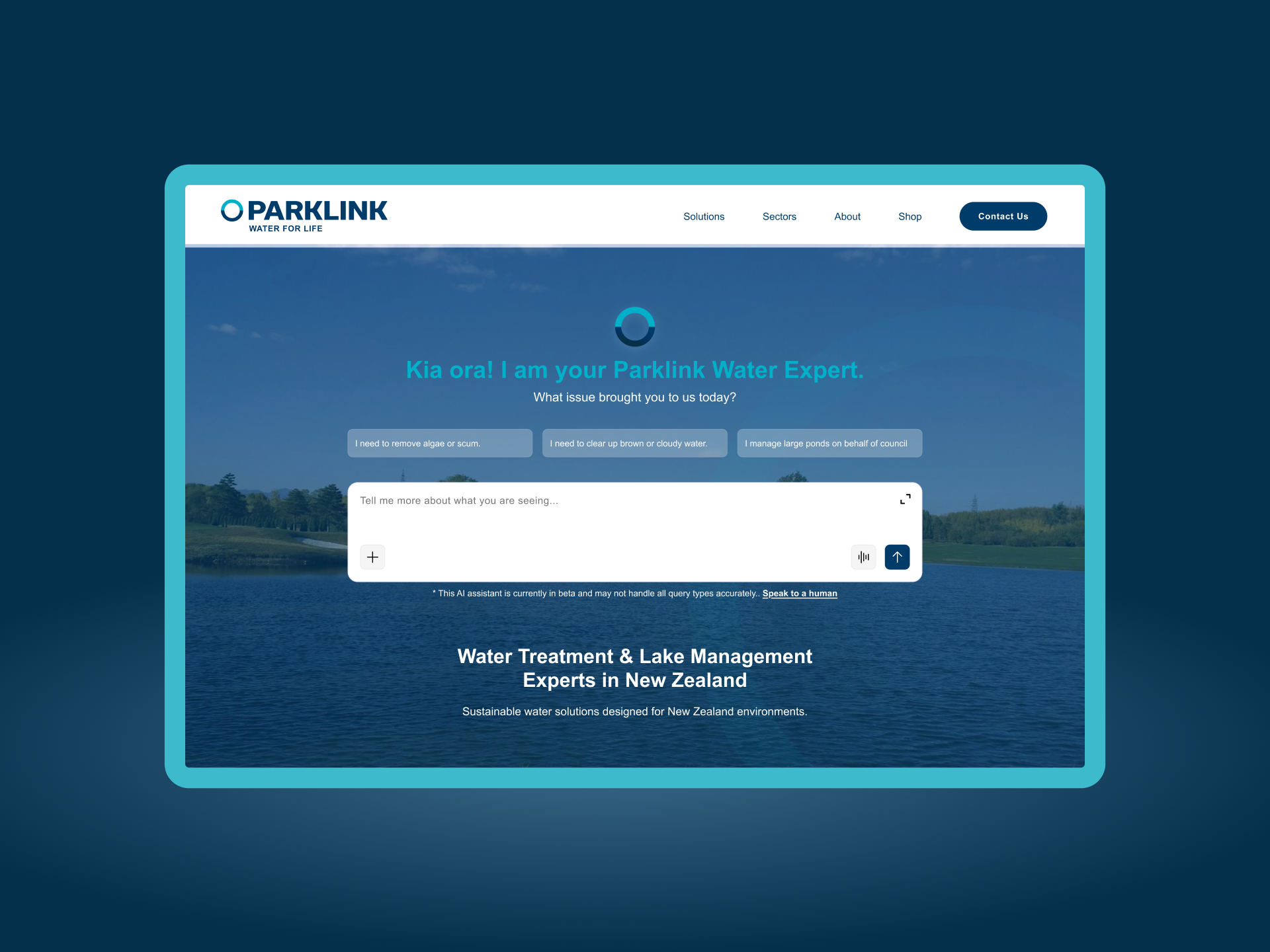
The final stage introduced the AI Water Expert. Customers could now describe their problem in everyday language or upload a photo of their water issue, allowing the system to analyse the situation and recommend an appropriate solution. This removed the need for customers to understand technical terminology before taking action.
Key Impact
Turning Digital Problems Into Business Opportunities
The transformation changed Parklink's digital position completely. The website moved from an unstable, slow-loading platform into a reliable, fast business asset capable of supporting ongoing growth. The SEO structure moved from a confused collection of pages into a focused system designed around valuable customer searches.
The separation of New Zealand and Australia created two independent growth opportunities. Instead of one website trying to serve different markets, Parklink now had dedicated digital platforms designed for each audience.
The council email outreach and the council and golf landing pages gave Parklink a way to reach its two priority commercial segments directly, rather than waiting for organic rankings to build. This meant council and golf-sector enquiries could be generated in parallel with the longer-term SEO gains, instead of the business relying on a single channel.
The customer experience also improved significantly. Visitors no longer needed to understand Parklink's internal product structure. They could begin with their problem and discover the right solution through a clearer journey.
The AI product finder created a new way for customers to engage with Parklink. Residential customers could receive guidance without immediately contacting sales, while more complex commercial enquiries reached the team with better context.
Why It Worked:
Solving the Right Problems in the Right Order
The success of the project came from treating SEO as a complete digital system rather than a simple keyword exercise. The website needed to be fast and stable before optimisation. The markets needed separation before targeting. The keywords needed to be grounded in real customer language before content could rank for the right reasons. The content needed structure before rankings could improve. The council segment needed direct outreach and a dedicated landing experience because it could not wait on organic search alone. The AI needed a reliable knowledge base before it could create meaningful recommendations. Every improvement was connected. The technical rebuild created the foundation. The SEO strategy created visibility. The outreach and landing pages created direct commercial reach. The UX improvements created better journeys. The AI solution improved conversion. Each stage strengthened the next.
Why it Stands Out
A Digital Platform Built for Continuous Growth
Today, Parklink operates two stable, fast, independently optimised digital platforms designed for New Zealand and Australian audiences. The website that once struggled with crashes and slow load times now supports ongoing development. The index that was filled with unnecessary pages now focuses Google's attention on valuable content. The customer journey that was once unclear now guides visitors towards the right solutions.
The transformation created the foundation. The ongoing SEO and optimisation programme continues building on that foundation by expanding keyword visibility, improving content performance, refining the AI experience, and creating new growth opportunities.
Parklink's journey shows that digital growth is not created by one single tactic. It comes from rebuilding the right foundations, understanding customer behaviour, and creating technology and outreach channels that help people find and choose the right solution.